
Tashik-tash
70,000 years ago, a small band of Neanderthals were crossing through the Bajsuntau mountain range in a remote area of what is now Uzbekistan. They stopped at a place called Teshik-Tash Cave long enough to bury a child, a young boy of about 8 or 9. He was lovingly wrapped in animal skins, and five pairs of Siberian Ibex horns were positioned arching over and surrounding the child.
Was this an attempt to protect the boy from scavengers, like hyenas, or a fear of something far more sinister? Was it something they knew and feared or something they did not know and feared even more? After the burial they all moved on across the mountains and down through the passes, south toward the dry plains of Afghanistan.
This series grew directly out of that story — one of the oldest deliberate burials known to archaeology, and one of its strangest. There is no way to know what the Neanderthals who buried that child understood about death, fear, or the world beyond their cave. What survives is only the arrangement itself: a small body, carefully wrapped, ringed by horn after horn, as if to build a wall against something that could not otherwise be kept out.
Each of the fourteen paintings in this series approaches that scene obliquely rather than illustratively. Figures emerge from saturated, sprayed and pooled fields of color — burnt orange, deep teal, ash grey — their edges never fully resolved, closer to afterimage or memory than portrait. The recurring vertical form, crowned in fire-colors and trailing into darkness below, moves through the series as father, mother, boy, and finally as unnamed others: hunter, stranger, wolf. Titles carry the narrative; the paint carries the feeling underneath it — tenderness, dread, and the particular ache of a grief 70,000 years old and still, somehow, legible.
Scroll down to see the entire series:

The Family
Three robed, orange-crowned figures drift together against a pale ochre ground, their forms trailing off into mist below the waist. The largest anchors the center — the band itself, moving as one body through the mountains.
watercolor & ink on paper 19 x 23 inches framed

His Father
A solitary dark form rises from a muted, storm-colored ground, its crown scorched rust and orange, a faint teal aura bleeding at its edges. The first in the sequence of single portraits — solid, watchful, protective.
Watercolor & ink on paper 10 x 8 inches

The Boy
Small, dense, and centered on the page, this figure carries a bright orange core beneath a blackened crown — a compact, contained energy. The emotional center of the series: the child at the heart of the story.
Watercolor & ink on paper 10 x 8 inches

His Mother
Set against a luminous teal-and-gold field, this figure is softer and more atmospheric than its companions, its edges dissolving into color rather than holding a hard silhouette. The gentlest presence in the series.
Watercolor & ink on paper 14 x 11 inches

The Cave
A dense, irregular mass of black ink sits against a cool turquoise ground, a single rust-colored bloom marking its upper edge like torchlight at a mouth of stone. The most purely architectural image in the group — shelter, enclosure, and threshold at once.
Watercolor & ink on paper 10 x 8 inches

The Vision
A dark, drifting form hovers within a field of burnt orange and red, a small wound of crimson pulsing at its center. The palette turns from earth to fire here — premonition rendered as color.
Watercolor & ink on paper 10 x 8 inches

The Burial
A hunched, descending form sinks into a warm sepia ground, a pale halo of turquoise marking the air around it. Quiet and gravitational — the weight of the act itself.
Watercolor & ink on paper 10 x 8 inches

When the Wolves Come
A shadowy vertical form is struck through at the crown by a violent bloom of magenta against a field of green and gold. The most urgent, unsettled image in the series — the fear the family could not name.
Watercolor & ink on paper 10 x 8 inches

The Journey South to Afghanistan
A faint ember of orange glows within a grey-green haze, the figure nearly dissolved into its surroundings. The quietest, most distant image in the series — the band already receding into the mountains, moving on.
Watercolor & ink on paper 14 x 11 inches

The Ibex Horns
Twin curling black tendrils rise like horns from a blackened crown wreathed in gold and orange, set against clear blue. The most direct visual reference to the burial ritual at the heart of the series — the five pairs of ibex horns arched over the child.
Watercolor & ink on paper 10 x 8 inches

The Grave
A twin-lobed black mass, almost heart-shaped, sits low on a warm tan ground beneath a faint turquoise halo. Symmetrical and still — the site left behind after the band moves on.
Watercolor & ink on paper 10 x 8 inches
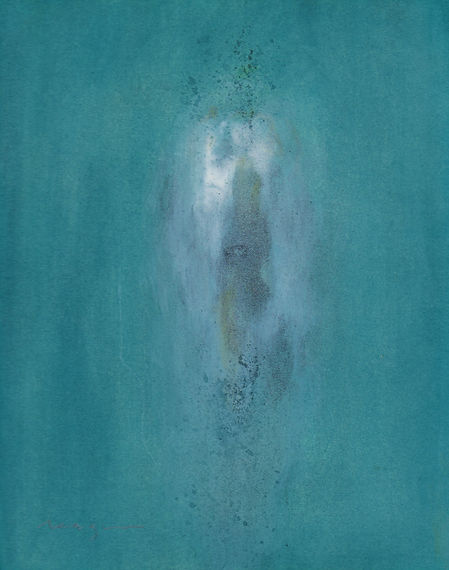
The Whiteness of Bone
A pale, ghostly silhouette barely separates itself from a saturated teal ground, more absence than presence. The most dematerialized image in the group — the figure worn down to its palest trace.
Watercolor & ink on paper 10 x 8 inches

The Other
A dark, bristling form with an orange crown stands apart on a field of green, thin teal drips falling from its shoulders like rain or unraveling thread. Its title carries the series' undercurrent of an unnamed threat.
Watercolor & ink on paper 10 x 8 inches

The Hunter
A red-and-orange crown burns atop a dark, descending form on a cool grey ground — a watching presence, closer to threat than protector. The series' final image, left unresolved.
Watercolor & ink on paper 10 x 8 inches